Assassin’s Creed: Origins

Assassin’s Creed: Origins serves as a prime example of what happens when game developers refuse to skip out on even the smallest details.

Players take on the role of Ba Yek, a Medjay returning home to his village in ancient Egypt. Ba Yek is embarking on a trail that will reveal the mystery behind his young son’s murder one year ago. Along the way, he unravels a web of lies and deceit that extends to the highest-ranking members of the Roman Empire. Players also assume command of one of Ba Yek’s descendants roughly 3,000 years into the future, who – as in all Assassin’s Creed titles – looks back on her ancestor’s journey while attempting to avoid the dangers of the modern world.

The game’s delivery and knowledge of history is unparalleled. Players are given a clear understanding of Egypt’s history during a time when women – predominantly the pharaoh Cleopatra – largely governed and subjugated the business and goings-on of one of the period’s leading nations. Her relationship with Julius Caesar of Rome is also detailed in earnest fashion, despite a few romanticized elements thrown into the mix.

In terms of action, Origins provides even the most die-hard adrenaline junkies with new feelings and visuals. The game offers a wide array of weaponry and upgrades, garnered after bursts in one’s overall strength, that allow for swift improvements in a player’s overall attacks and defense. Then, there’s the gorgeous landscapes (from deserts to pyramids to leafy mirages) one will experience on the back of a trusty horse or camel in what is arguably one of the most beautiful-looking games of the last ten years.

Two specific portions deserve mention, the first being the naval battles. At certain points, you’ll assume the role of Aya, Ba Yek’s wife, who assists her husband in his investigative mission of vengeance. Aya commandeers the slave ships that engage in battle with the naval fleets of Pompeii, Cleopatra’s brother and Egypt’s competitor for the throne.

The second is a dream sequence involving a giant snake. I fear giving away too much here and will only say that both sections make for some of the most heart-pounding moments in the Assassin’s Creed franchise.

This was my first venture into Creed territory, and though I enjoyed myself thoroughly, many of my gaming friends criticized my decision to mark this as my official entry. With a subtitle like “Origins” following its name, however, this seemed like the prime option. After all, “origins” implies this is where everything started. Shouldn’t every story or trip begin at the beginning?

I’ve since attempted other Assassin’s Creed games, including Syndicate and Unity, and while both were fun, neither compared to the overall stamina of Origins, which boasts stronger exploration tactics and much simplified controls. I’m just grateful I don’t have to press any extra buttons to run…

The boss fights in this game are exciting, and the voice acting of Abubakar Salim as Ba Yek and Alix Wilton Regan as Aya gives these characters their life. While playing, we’re not staring at a simulated couple; they feel like real people. Their plights become our plights; we share their concerns and worries, as well as their joys, and the power in these characters’ vocals deserve special credit.

My only issue with this game is its length. My first playthrough, including side missions, took nearly two weeks, though to be fair, I wanted to finish this game in full; nothing left behind. Some of the side missions either leave little to the imagination or serve no purpose. Overly long and sometimes boring, these side mission detract from the initial focus of the game, though many must be completed to build one’s XP points. Without them, players cannot reach the strength levels necessary to move ahead in the main story. Probably not the best way to handle an RPG; why not keep the story and side missions fully separate for players interested in campaign only?

Either way, Assassin’s Creed: Origins is a blast that’s sure to give even the most experienced players something new to think about. From its opening credits to the gut-wrenching and emotional ending, Origins stands as one of the most heartfelt and proficient titles of 2017.

Score: ****1/2 out of ***** (4.5 out of 5)

Image courtesy of Digital Trends

Uncharted: The Lost Legacy

Uncharted: The Lost Legacy warrants a few playthroughs before one can really appreciate its action and detail. If you’re like me and this was your first trek into Uncharted territory, the controls and feel of the game will take some getting used to, but once that step is taken, you’re in for a rip-roaring adventure.

The story follows Chloe Frazier, a once-supporting character first introduced in Uncharted 2: Among Thieves. Nathan Drake is out of the picture while Chloe and Nadine Ross of Uncharted 4: A Thief’s End fame take center stage. Together, they work to uncover a hidden artifact – the legendary tusk of Ganesh – in India’s western Ghats while avoiding the path of a ruthless warmonger set on inciting civil war.

I admit my first reaction to The Lost Legacy was something of a mixed bag, and to accurately tell this tale, I must first discuss my primary qualm with the game: it’s length. At first, The Lost Legacy feels more like an experiment than an actual game. While other entries in the Uncharted series boast anywhere between 16 and 20+ chapters, this one offers only nine. From what I’ve read, the game was originally going to be a mere extension of A Thief’s End, though eventually, ideas sprung out of control resulting in a spin-off of sorts.

The Lost Legacy will likely require anywhere between 12 and 15 hours during your first play. When it was over, and the end credits began to roll, my reaction was a solid, “Meh.” For the most part, I felt relatively underwhelmed save for the game’s look. The action failed to make an impression on me, while the controls were outright confusing. This was my first exposure to the Uncharted series, and I wasn’t prepared for the extensive climbing, crawling and rope-swinging I was suddenly required to pull off. I put the game away and tried to move on…

But then, something strange happened. The game popped into my head the next day and refused to leave. I began revaluating everything I had seen and experienced and started wondering if maybe – as the game was short enough – a second playthrough was warranted. I eventually gave in, this time completing the campaign within eight hours, and I found myself completely blown away. From the weapons and stealth tactics to the game’s gorgeous environments, Frazier’s story had struck a delayed, yet powerful chord.

This game has a clear idea of what it’s trying to do. The writers have taken their time while crafting its brazen, yet natural-sounding dialogue. Chloe and Nadine share incredible chemistry together, and the action scenes are astounding. Both figures travel into rocky terrain, forests and even temples, carving their way through enemies and leading to the final level aboard a moving train that stands as one of the most exciting scenarios I’ve ever experienced in a video game.

The voice acting also deserves special recognition. Claudia Black, a regular as the voice of Chloe Frazier, returns in full form, bringing her usual sense of realism to a character that could otherwise be something a stereotype, and Laura Bailey is fantastic as Nadine Ross. Troy Baker is also back as the voice of Sam Drake, a character first introduced in Uncharted 4, and Baker is one of those voice actors that can do no wrong. He doesn’t just give his characters words; he gives them life. In just voices alone, Baker provides each character with unique qualities and traits, and Sam is no exception.

In his two Uncharted appearances, Sam sounds like someone we all know; a person that’s curious and mischievous, yet boasts good intent at the same time and who somehow always finds himself in the wrong place at the wrong time.

The Lost Legacy is one of the most real-looking games I’ve seen in a while. Every tree branch, leaf and bush you cross reacts appropriately to weather or takes on new form granted its crushed under your character’s jeep. Every visual detail, from the creases in a person’s face to the gray in one’s beard is offered special focus and attention. There were moments I had to remind myself I wasn’t watching a live-action film.

As with every Uncharted game, there are treasures and artifacts abound for your character to discover. If the story doesn’t keep you busy enough, the treasure hunting surely will. The puzzles are challenging without requiring too much time minus one section in the middle involving levers and moving statues. There are probably hundreds of combinations to choose from, but I guess that’s why we invented YouTube tutorials.

A final note: for anyone who suffers from vertigo or fear of heights, this game is probably not for you. The characters traverse some of the highest points and swing over massive canyons that are sure to hatch the butterflies in one’s stomach. I suppose, in this sense, there’s a downside to this game’s realistic appearance, but granted you’re unaffected, you’re almost guaranteed to enjoy yourself.

Score: ****1/2 out of ***** (4.5 out of 5)

Image courtesy of dualshockers.com

Doom (2016)

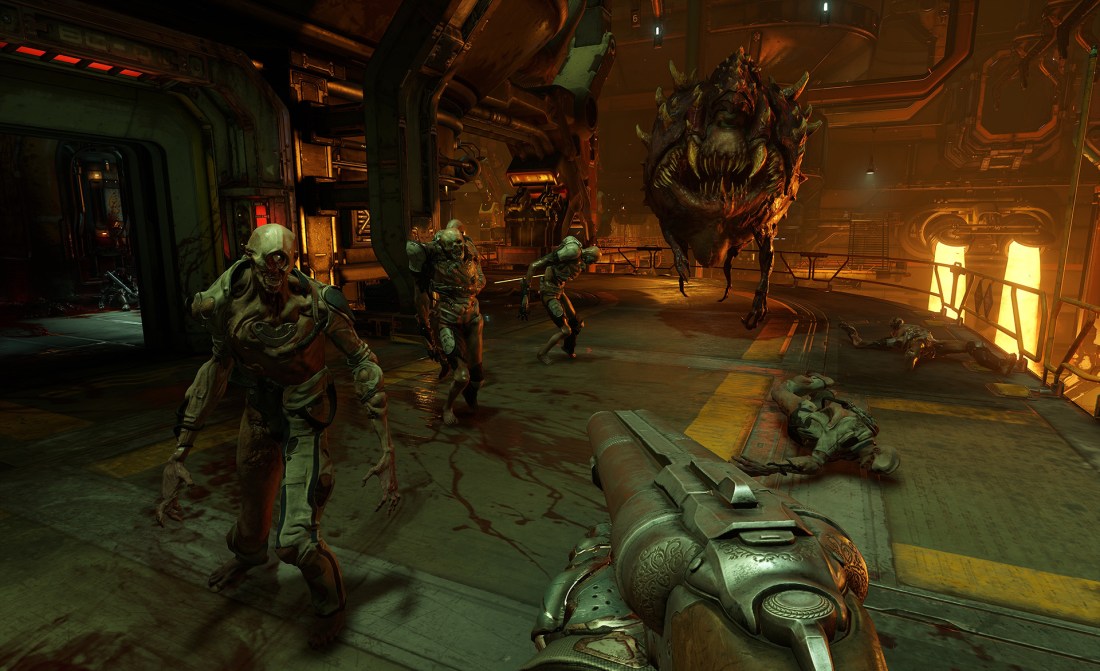
Doom is everything a game should be and more. It’s uncompromising without being excessively violent (at least not in a realistic sense) and offers some of the best graphics I’ve ever seen in a game.

The plot hasn’t changed much from the original 1993 venture. Players take on the guise of a space marine that must rid a galactic workstation from a demonic presence that has crossed over and now threatens to wreak havoc on Earth.

The game offers a lot of what made the original Doom so popular. Guns and weapons abound, including a couple of old friends like the BFG, and all those classic monsters from the imps and lost souls to the considerably tougher barons of hell that both scare and excite us at the same time.

What’s the main difference? With roughly 23 years between releases, the creatures are completely refined. Every detail from the wrinkles in their skin to the malice in their expressions is completely visible onscreen. The atmospheres are dark and visceral, and combined with one of the most intense video game soundtracks since 2013’s Killer Instinct, Doom is heart-pounding from the start.

In addition to the game’s look, Doom suffers from virtually no technical glitches or playing issues. Many modern PS4 or Xbox ventures contain such complicated code that it’s become nearly impossible to work them all out. Many times, players are fighting their way through a current section or level only to have the game freeze and spit out a blue error message (those who have played Assassin’s Creed: Origins know what I’m talking about), but not Doom

To be fair, the game has more than two decades under its belt. It’s based on one of the oldest first-person shooters around, and the developers have had lots of time to work out all the kinks, but the fact that they’ve done so warrants respect. Rather than sit back and sell this game “as is,” they’ve taken the time to give players a full experience without letting them worry about losing progress. It’s an ambitious feat that shows the devotion and strength of the development team, and each member deserves special commendation.

I was very surprised at the ease of the controls. The company behind Doom didn’t try to do anything fancy or special. Pushing forward on the left joystick causes the marine to run. You’re not required to press any extra buttons to garner speed; it’s all kept relatively simple. The controls have a fluidity I’ve yet to experience in any other game this year, and the character moves as freely as running water.

Aiming and firing your weapons is also easy. No more moving about the screen rapidly trying to get that perfect shot. Each weapon has a wide range of fire (minus the chainsaw of course), and most enemies are large enough to hit from any angle.

The game’s ending also serves as a friendly reminder of why humans should never trust creatures from the “other side.” They’ll always exploit you and let you down. Never give your humanity, principles or dignity up for wealth or power; it will always come back to haunt you. A nice moral touch to an otherwise splatter and gore-filled title.

Strangely, the game has stirred controversy due to its violence, and while the game is rough at times, the violence never stretches beyond the initial ropes of fantasy. Your character is destroying monsters and ghouls, not humans. Critics should probably take that as their first sign to calm down. The game is also short, warranting roughly 10 to 14 hours the first time around – probably not enough time to turn a player into a psychopath.

Doom remains one of my favorite titles thus far. From the graphics and battles to the killer music and creatures, players are bound to have loads of fun with it.

Score: ***** out of***** (5 out of 5)

Image courtesy of Nutroniks.com

Shadow of the Colossus

Shadow of the Colossus is one of those games that focuses so much on specific elements that a lot of what’s important is seemingly tossed aside. The venture follows a young warrior who must defeat large creatures known as “colossi” at the behest of unseen gods to resurrect the body of a young maiden he’s brought to their temple. All the while, a group of medieval-esque figures are in hot pursuit, hoping to stop the boy before his actions wreak havoc on the land.

Where Shadow truly succeeds is in its visuals. There are moments throughout this game of pure realism. From the environments to the horse you ride, everything looks exceedingly real to the point that I occasionally had to remind myself I wasn’t watching a film of sorts. The rock formations, the desert sands and the greenery of the world you play in bring a lot to the table and make this one of the most realistic-looking games I’ve ever encountered.

Now, the colossi… Each entity is truly unique and has its own fighting style. This is a great way to keep players on the edge and guessing as to what enemies might do next. They are as unpredictable in their maneuvers as they are in their looks, and while some creatures are easier to defeat than others, all are visually striking, so on a purely graphical level, Shadow is a triumph of the ages.

Nevertheless, I found it hard to care about this game, primarily due to its story – or lack thereof – and lagging character development. None of the main figures are ever introduced by name except for Agro, your horse. In fact, the only other name I came across was that of the main character, Wander, and I only discovered this through post-game research.

The woman Wander struggles to resurrect is never given a clear background. Who is she, exactly? Is she Wander’s wife? His sister? A cousin? Why is Wander so desperate to bring her back? The game ends, but the mystery is never solved. Are the people out to stop Wander his family members, or angry villagers simply looking to put a dent in a young boy’s hopes? Again, we never find out. These characters are never given their due, and thus we feel little to nothing for them.

There are so many unanswered questions in this game, and it’s clear the developers were intent on providing players with a visual treat, which they accomplish in spades, but visuals often work like frosting on a cake. It tantalizes our taste buds and offers substance to what could otherwise be a plain concoction of eggs and flour, but one’s bound to get bored right away without a full-fledged pastry underneath, and Shadow is no exception. Without a story and clearly defined relationships, the visuals can only provide so much intrigue before players start thinking about something else.

The game is not particularly difficult; once the first battle concludes, individuals will get an immediate feel for the controls and how the rest will play out. I spent about ten hours on Shadow before reaching the end and never perished during a fight. I’ve also read many online complaints regarding the controls surrounding Agro, your horse, though I experienced few problems in this area.

Overall, Shadow is a great-looking adventure that feels somewhat empty at its core. The thin plot won’t be enough to keep players interested, nor does the game offer enough of a challenge to warrant future replays. Shadow is an alleged remake of a PS2 title that emerged in 2005, and though I haven’t played the original myself, I can’t help but wonder if there was ever enough material the first time around to warrant what is a no-doubt fetching, yet emotionless, retread.

Score: *** out of ***** (3 out of 5)

Image courtesy of Gearmuke.com